






Founder’s Letter
By Oren Cass

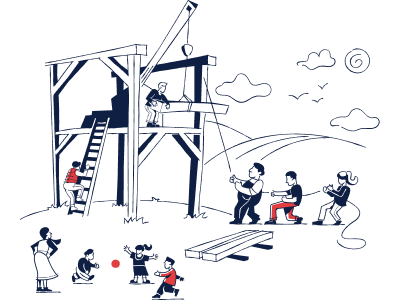
For our first five years, American Compass relied exclusively on nautical metaphors. As the word “Compass” suggests, we saw our task as navigating through the unknown, guided by fixed principles but uncertain what our destination held in store. The covers of our annual reports tell the story—the launching of a New Flagship, Charting the Conservative Course, Breaking Through, Turning the Tide, and then finally: The New World.
This annual report looks quite different, on its cover and in its substance. We are no longer refugees from a failed regime hoping to reach a better future. We have arrived, and we are staking our claim. A compass can aid intrepid explorers adrift in a vast ocean; it also helps settlers map their surroundings, build their infrastructure, expand their territory. This year, we launched Commonplace, moved into real office space, hosted a black-tie gala headlined by the Vice President and Secretary of State, published The New Conservatives, and became generally recognized as the most influential and effective policy organization on the New Right.
How do we do this? Lots of organizations conduct research and publish op-eds. Are ours better designed and written? No doubt. Does it help that our ideas are better too? Surely. But as important, we have impeccable credibility as good-faith actors, determined to get the answer right and tell the truth regardless of whose “team” likes it or not.
No other organization could be called both “the most intellectually honest tendency within the anti-Establishment right” by New York Magazine and “the cutting edge of populist economic and cultural thinking” by Steve Bannon. No other organization could have both the Teamsters and BlackRock proudly sponsor its fifth-anniversary gala.
Continue reading the Founder’s Letter…
Year in Review

Five years after our founding, our surroundings have changed. That doesn’t just mean our office, which has moved from a coworking space to a converted yoga studio to, as of this year, a building four blocks from the White House. It means America.
The phrase of the year among the American Compass team might have been “the Overton window is shifting.” We heard it repeated casually around our conference table and, much more formally, from the Vice President during our black tie gala. It was our expression of choice when speaking to members of the media about trade and budget priorities. What else could describe a paradigm change on the scale of what Americans experienced this year?
“American Compass policies look a lot like policies Trump has enacted or considered, and the group has punched above its weight in cultivating powerful GOP allies—including Vice President Vance and Secretary of State Marco Rubio, both of which Trump has said could lead the MAGA movement after he is gone.”
Emily Brooks, The Hill
Early this year, roughly three-dozen members of the American Compass network, including members of our staff, our boards, and our membership group, took up high-ranking positions across nearly every federal agency and the vital offices within the White House: Treasury, State, Defense, Justice, Labor, Commerce and USTR, the FCC and FTC; the offices of the Vice President, legislative affairs, science and technology, and personnel; the domestic policy council and the national economic council; and more. Others moved into new positions as chiefs of staff, legislative directors, and senior policy advisors for congressional offices.
“New organizations have sprung up to challenge the old conservative consensus and provide intellectual firepower to the populist right. Chief among them is American Compass, a five-year-old think tank headed by Oren Cass, a onetime domestic-policy director for Mitt Romney’s presidential campaign who has emerged as perhaps the pre-eminent voice in favor of right-wing protectionism in policy circles.”
Molly Ball, Wall Street Journal
American Compass’s core philosophy, one that values human thriving over market fundamentalism and American industry over free trade absolutism, is “clearly ascendant.” We have not let this momentum go to waste.
This year, we achieved several milestones which captured the attention of national leaders, the media, and the public.
Commonplace Magazine

We started Commonplace as a new home for the New Right.
Commonplace was designed to be a publication shaped by ideas, not news cycles, where stories were chosen by their relevance to kitchen table debates, not the interests of a media elite.
As Oren Cass explained when we launched, “Our magazine’s purpose is twofold: First, to be a common place where not only the American right-of-center’s diverse factions, but also thoughtful interlocutors from across the political spectrum can gather to debate the future of both conservatism and the nation. Second, to focus those conversations on the commonplace—the economic, political, and cultural concerns that shape the experiences of ordinary Americans and, as a result, the trajectory of the American experiment.”

Since Commonplace’s founding in January, the magazine has published over 200 pieces ranging in topics from Florida’s E-Verify mandate to Medicaid cuts to deaths of despair in middle America. It has featured authors with day jobs ranging from an electrician to labor union president to the Vice President of the United States.
The stories featured in the magazine are often prescient. A January piece by Leah Sargeant exposing medical malpractice present in the deaths of pregnant women falsely labeled the victims of abortion bans was published months before ProPublica’s controversial 2025 Pulitzer win for their erroneous reporting on the same subject. An article from Jonathon Van Maren examining the slippery slope of assisted suicide was published weeks before a major piece from The Atlantic catapulted the topic in the public discourse.
We highlighted some of the smartest voices to bring new perspectives to the news of the day. Commonplace‘s “After Liberation Day” series in the wake of President Trump’s April tariff announcement gave readers access to new, and at times, conflicting viewpoints on the biggest story in America.
We have remained thoughtful about how Commonplace can capture public attention in a crowded media ecosystem. In August, we integrated the magazine into Substack’s publishing platform, a move which substantially increased readership. Fully integrating Oren Cass’s Understanding America and the American Compass Podcast created a one-stop-shop for American Compass’s editorial content. We have also invested in the Commonplace team, bringing on board a full-time editor to round out the magazine’s three-person team.
This year, Commonplace went from a fledgling publication to capturing the attention of headline-makers, from Ross Douthat to Charlie Kirk to Martina Navratilova. The magazine is living up to its slogan—we are the place to find out what matters in America.
The New World Gala
In June, we celebrated. The New World Gala, held in honor of American Compass’s fifth anniversary, was held at the National Building Museum and was attended by members of the President’s cabinet, the Senate and House, and members of the White House press pool, along with over a hundred of our members and their families, including (in typical American Compass fashion) a black-tie-clad crowd of children.
“A who’s-who of Republican elites is set to gather Tuesday at the National Building Museum for a swanky gala hosted by American Compass, the institutional home of conservative economic populism in Washington. The black-tie affair is nominally being held to commemorate the fifth anniversary of the think tank, which was founded in 2020 by the conservative economist and former Mitt Romney adviser Oren Cass. But among American Compass’s supporters in the capital, the event is broadly understood to represent a victory lap of sorts, marking the ascendancy of Cass’s brand of economic populism.”
Ian Ward, POLITICO
The gala wasn’t just a chance to toast five years of American Compass’s work. The New World Gala made headlines as a “preview of a post-Trump Republican Party.” Instead of dwelling on past accomplishments, the night’s speakers, including American Compass’s executive director Abigail Ball, founder and chief economist Oren Cass, along with Secretary of State Marco Rubio and Vice President JD Vance, all looked towards the future.

Secretary of State Marco Rubio took the stage first. After an introduction from American Compass’s policy director Chris Griswold, Secretary Rubio spoke about how misguided globalization left America weakened, and how to set our country back on the right course.


Vice President JD Vance provided the second keynote in the form of a sit-down conversation with Oren Cass. The two discussed the Right’s ongoing political realignment, and the future of the conservative movement.
“This is not a five-, or a ten-year project. This is a 20-year project to actually get America back to common sense economic policy.”
Vice President JD Vance at the New World Gala
Another highlight of the night was the inaugural Robert E. Lighthizer Award. Given in honor of former U.S. Trade Representative Robert Lighthizer, this distinction was presented to three young leaders who have done substantial work to build this movement: Wells King, Jacob Reses, and Caleb Orr.

The New World Gala marked the beginning of American Compass’s venture into uncharted waters. There’s no need to retire your tuxedos yet—we’re already looking forward to next year.
The New Conservatives
Our work at American Compass tends to fall into two categories. There is the minority of our research, writing, and policy recommendations, which reacts to the news of the day. The majority of our work, on the other hand, tends to be far more forward-looking. Thinking about the challenges of tomorrow often puts us in the enviable position of the first mover, sometimes by a few years.
From the rising popularity of organized labor among the right-of-center to the seismic shifts on trade, our work gained new relevancy in the past year. It was time to brush the dust off our archive and meet the moment.

Enter The New Conservatives, a compendium of five years of American Compass’s most influential writing. The book, which was released in June, contains essays written by authors like then-Senator Marco Rubio, former U.S. Trade Representative Robert Lighthizer, Julius Krein, Elbridge Colby, and a host of American Compass regulars past and present, including Oren Cass, Chris Griswold, Wells King, Helen Andrews, and more.
“Forging a path towards a pro-American capitalism that protects our nation’s interests and serves the common good will not be easy… It will not be the work of one person or one party. To succeed, it must be the work of an entire generation and cross the entire political spectrum. It must become our new consensus.”
Senator Marco Rubio, The New Conservatives
For a book written from almost entirely previously published material, the attention The New Conservatives received was all new. The book gained interest from mainstream and conservative media outlets alike. To the former, it was a Rosetta Stone for a newly ascendent populist movement, to the latter, a roadmap for where conservatives can go after President Trump.

The New Conservatives goes beyond its role as an anthology of American Compass’s most prescient work to provide a forward-looking policy roadmap for legislators, policy professionals, and those simply interested in giving America a better path forward.
Membership
American Compass’s success is largely a credit to our recognition that a political movement can’t live solely in a white paper. Our ideas take root because we share them, most often through personal relationships with both elected officials and young policy professionals eager to carry our work forward.
On The Hill
This year, we expanded on the success of our summer Crash Course series. Delivered to routinely packed rooms in the Capitol, this weekly series of lectures covered the basics of American Compass’s philosophy, from conservative economics and family policy to labor and tariffs. Alongside the typical policy discussion, we held a session called “How To Make It In DC” aimed at interns and junior staffers looking to gain their footing in the political world.

Membership
Our membership program may be the most important thing we do at American Compass. Nearly 300 individuals from professional backgrounds ranging from policy to academia, law to media have been selected for the membership because of their genuine enthusiasm for American Compass’s work and their ability to be effective ambassadors for the movement.

In 2025, we hosted dinners, happy hours, and small group convenings aimed at engaging, educating, and expanding our membership. Our flagship event each year is our member retreat in Cambridge, Maryland. The retreat has become a can’t-miss event for many of our members and their families, with some traveling across the country to attend.
This year, the member retreat’s programming included high-profile guest speakers from both the federal government and the technology sector, along with lively breakout sessions on issues like rethinking globalization, the abundance agenda, and birthright citizenship. For the many member families in attendance, a highlight of the member retreat was the family cookout (complete with s’mores) overlooking the Choptank River.

Feedback during the retreat gave us new ideas with how to better engage our members. This year, we debuted the first of our new member coalitions and cohorts, small groups designed to connect members over a shared interest or industry. These smaller groups serve as a way to keep the conversation going, and build on the momentum of events like our topical small dinners.
Globalization
This year, the paradigm shifted.
Since the end of the Cold War, trade policy has been dictated by absolutism and inertia. The old wisdom—that trade will be conducted between benevolent actors, that comparative advantage will fine-tune productivity, and that trade deficits are self-correcting, continued on as talking points long after they were disproven. Dissidents were quickly dismissed as unserious non-experts who should be quickly dismissed if they were even heard at all.
Paul Krugman: I don’t think I ever said that. I think I said the trade deficits are not a problem.
Oren Cass: No. You wrote a piece for the American Economic Review in 1993, in fact titled, “What Do Undergrads Need to Know About Trade?” in which you said we need to teach them “that trade deficits are self-correcting.”
Paul Krugman: Okay, if I did say that, that was naïve…On with Kara Swisher Podcast, February 17, 2025
Then, reality got in the way. Issues that we had been highlighting for years, like the “China Shock” and the existential risks of a hollowed-out American industrial sector, received the notice of the White House. During President Trump’s inaugural address, he hinted at what was on the horizon, saying “I will immediately begin the overhaul of our trade system to protect American workers and families. Instead of taxing our citizens to enrich other countries, we will tariff and tax foreign countries to enrich our citizens.”
We stood at the helm, ready to advise this new administration as they steered through uncharted waters. In March, policy advisor Mark DiPlacido published a slate of recommendations targeted at leveling the U.S. trade deficit titled “A New Trade Paradigm.”

DiPlacido wrote: “the United States must take a more comprehensive approach to addressing its trade deficit that holds both our allies and adversaries accountable. The reciprocal tariff paradigm proposed by the current administration offers an opportunity to pursue balance with our trading partners, addressing specific trade barriers as well as more significant structural barriers that drive up the U.S. trade deficit. If carried out consistently and effectively, such an approach could rectify a world trade order that severely disadvantages the United States and yield enormous benefits to our economy, industries, and workers.”
Then, the White House did just that. On Liberation Day, we had the chance to lead the conversation around trade and tariffs in a new way. In an avalanche of media appearances, members of our team translated policy to the public, and became go-to talking heads for major media outlets trying to decode what these new tariffs would mean.

This spring marked never-before-seen momentum to eliminate our trade deficit. However, we understood Liberation Day to be a starting gun. We offered guidance on how to best implement these new trade policies in policy papers, direct meetings with administration officials, and the pages of America’s top newspapers.
We are focused on providing legislative footholds to give protectionist barriers, like a 10% global tariff and ending permanent normal trade relations with China, the longevity to exist long beyond the current administration. We have worked closely with lawmakers like Representative Jared Golden who are writing legislative proposals to codify the administration’s tariff policies. Our Capitol Hill Crash Course session on trade was packed with junior Senate and House of Representatives staff eager to hear what we had to say.
Over the course of a year, our work on trade has taken American Compass from an outlier to a trailblazer.
Industry
“Across the American economic dashboard, warning indicators are flashing red,” wrote Oren Cass in Foreign Affairs in January. The costs of a hollowed-out industrial sector have long been clear, from national security vulnerabilities to the erosion of the middle and working classes.

This year, with the beginning of the second Trump administration, we gained a powerful ally in the effort to revive American industry. In remarks published in Commonplace, Vice President JD Vance called for a great American industrial comeback.
We focused on re-forming the building blocks of American industry. In March, we published a policy brief addressing the United States’ severe deficit in critical minerals production. The brief recommended the use of the Defense Production Act to provide financing for new critical minerals projects and establish price stability. Later that month, President Trump issued an executive order making a large part of those recommendations reality.
“The United States has finally woken up to the fact that we can fight back.”
Chris Griswold on Representative Claudia Tenney’s introduction of the CHIPS Act
We also helped form a coalition of policy experts reimagining American industrial policy for the future. The Techno-Industrial Policy Playbook is a collaboration from American Compass, the Foundation for American Innovation, Institute for Prosperity (IFP), and New American Industrials Alliance (NAIA) Foundation, containing 27 ready-to-implement policy proposals on everything from redesigning NEPA to reviving the medical industrial base. American Compass’s Oren Cass and Chris Griswold authored proposals on taxation for innovation and training a workforce capable of revitalizing America’s industrial capacity.
At one of the highest-profile events focused on rebuilding American industry, the Reindustrialize Summit in Detroit, Michigan, senior administration officials and cabinet members seemed to be reading from the American Compass playbook. Counselor of the Department & Director, Office of Policy Planning at the Department of State, Michael Needham said “In the 21st century, America and its civilizational allies will face a choice. We can do the work to rebuild our nation. Or we can watch as our technology and our national defense are held hostage to regimes that share neither our way of life nor our aspirations as a country and civilization.” In his keynote address, U.S. Trade Representative Jamieson Greer stressed, “We must strive to create a society where an individual can find a good job in their hometown, a job that provides prosperity, purpose, and dignity.”
We placed a particular emphasis on communicating these principles to policymakers on Capitol Hill. The launch of the Techno-Industrial Policy Playbook was kicked off with remarks from Senator Todd Young and attended by over 100 interested staffers.

“When it comes to innovation, the news of America’s demise has been greatly exaggerated. We still have the most talented, dynamic, hardworking, and creative citizens in the world—an advantage inherent in free people.”
Senator Todd Young, on the launch of the Techno-Industrial Policy Playbook
At Commonplace, we highlighted some of the leading voices on reindustrialization, including podcast conversations with energy policy expert Robert Bryce on the critical minerals crisis and the threat of a new China Shock with Council on Foreign Relations senior fellow Brad Setser. Commonplace also helped set the record straight that reindustrialization isn’t just necessary, but popular. On-the-ground reporting by Ethan Dodd in Pennsylvania profiled the manufacturing workers who helped deliver Trump the 2024 election, and the Heritage Foundation’s Parker Sheppard helped rebuke a Cato Institute-led falsehood that Americans don’t want to work on factory floors.

This year, we capitalized on momentum to help fine-tune policy proposals, working to answer not the question of if America should reindustrialize, but how.
Tech
How do Americans navigate a tech-focused future?
The newest phase of the information revolution has allowed personal technology to reach previously-unimaginable levels of ubiquity, with smartphones and social media becoming a near-prerequisite for participation in public life at nearly all age levels. At the same time, AI’s development has led to new questions about how increasingly sophisticated technology can fit into our society and economy without creating harm.
This year, we leaned on our members and coalition partners to address how technological innovation can be compatible with human thriving. During our annual member retreat in April, a session focused on family-first technology received strong interest.

The following month, we hosted a salon-style small dinner on the topic “AI, Friend or Foe of the American Worker?” and this summer our newly-formed Tech Policy Caucus met up for its first happy hour event. We helped elevate important perspectives, like the argument Federal Trade Commission Andrew Furgeson provided for Commonplace on how Big Tech puts children’s safety in jeopardy.
Spirited conversation gave way to more focused planning, and we partnered with the Foundation for American Innovation and the Heritage Foundation to host a first-of-its-kind Age Verification Summit, focused on how to effectively deploy methods to make technology safer for minors.

This input helped members of our team capture headlines for their tech policy recommendations. Executive director Abigail Ball was featured in the New York Post for her writing on how workers and policymakers can address AI’s encroachment on white collar careers. Director of programs and education Brad Littlejohn wrote about the harm posed by unchecked online access to pornography for children and adults alike, and explored a more hopeful technological future during a presentation at the Academy of Philosophy and Letters’ conference on “The Purpose-Driven Tech Life.”
Our work helped shape public and private discourse that grappled with tech’s new ethical challenges while remaining pro-innovation.
Labor
We are in the middle of a seismic, generational shift of public attitudes towards organized labor. From Teamsters President Sean O’Brein taking the stage at the Republican National Convention to the appointment of pro-union Secretary of Labor Lori Chavez-DeRemer, unions are ascendent. For the first time in decades, American workers are a constituency that the right-of-center can no longer afford to ignore.

“Cass, perhaps more than any other figure in American conservative politics, has been challenging Reaganite economic orthodoxy, questioning shibboleths around free trade and free markets, and locating the worker, not the capitalist, at the cause of American prosperity.”
Sebastian Milbank, The Critic
American Compass has long been tracking this shift, which was succinctly captured in our recent survey. In May, we partnered with YouGov to poll 1,000 Americans about their attitudes toward unions and proposed labor policy reforms. The results illustrated the changing tide; younger Republicans were much more likely to support unions than their older counterparts. As American Compass policy advisor Daniel Kishi told the New Yorker, “the generational divide captured by the survey is mirrored among Republican elected officials, with those who entered office after the 2008 financial crisis—such as Hawley and Vance—more likely to view unfettered markets skeptically and to see rank-and-file union members as potential supporters.”

As pro-labor voices gained political traction, we were ready to meet the moment. Our team offered counsel to the new administration on worker-supportive policies. We also provided Congressional staff with resources to help write pro-worker policies, with our Capitol Hill Crash Course session on “Pro-Worker Conservatism” commanding a standing-room-only crowd.

We also thought about how to grow union membership. A paper released in July called “Organized Labor’s Democratic Deficit” by Daniel Kishi outlines how the decades-long decline in union membership can be partially traced to the disconnect between unions’ political stances and the opinions of would-be members.
American Compass has always viewed worker power as central to America thriving. This year, we made substantial progress to make this view the consensus.
Financialization
This year, we rejected market fundamentalism. The idea that financial markets could guide our country’s priorities—instead of the other way around—is a falsehood. Financialization serves the wealthiest citizens and institutions at the expense of America’s workers, industrial capacity, and national security.
“If conservatism stands for anything, it is the proposition that what matters and is worth defending is not measured mainly in dollars.”
Oren Cass, Commonplace
We had the chance to collaborate with high-level appointees in the Trump administration who share this conviction. During her first address on antitrust, Assistant Attorney General Abigail Slater quoted Oren Cass while explaining why conservatives should be skeptical of concentrated economic power. Cass also had the opportunity to moderate a keynote discussion between Slater and Federal Trade Commission Chair Andrew Ferguson on antitrust under the Trump administration.
In April, we hosted a fireside discussion with FTC Commissioner Mark Meador. The conversation (Meador’s first public conversation since his confirmation) focused on Meador’s conservative vision for antitrust reform.

We also took a critical stance against private equity’s further hollowing-out of American industry. In Commonplace, Cass wrote about the moral arbitrage used in private equity’s takeover of everything from veterinary clinics to funeral homes and captured the changing sentiment that empowered Ohio Senator Bernie Moreno to rally state leaders and organized labor in opposition to private equity taking over a century-old paper mill.
This work challenged, to quote Cass, “the old establishment that would respond to private equity shutting down a 100-year-old plant with a press release declaring, ‘I am extremely disappointed.’” We also helped reframe the long-held wisdom among the right-of-center that profits, not principles, should be the top priority.
Tax & Budget
We no longer exist in Paul Ryan’s Washington. However, deficit-expanding tax cuts seem to have held onto their spot in the right-of-center playbook. No one would deny that the federal budget deficit is a problem: we are looking down the barrel of nearly $2 trillion, more than half of which is driven by the interest payments on previously-existing debt.
It’s time to get serious about balancing the budget through more than arbitrary spending cuts. Tax increases should be on the table, as should a strategy-driven reshaping of America’s defense and health care spending.
A single-minded focus on tax cuts is out of step with what our federal budget can handle and what the American people truly want. As Oren Cass wrote in the New York Times in February:
“[Groups like Club for Growth, Americans for Tax Reform and Americans for Prosperity] preach tax cuts with the same desperate zeal as climate activists demanding a near-total elimination of carbon emissions. They oppose tax increases, no matter how large the deficit, with the same determination that open-borders advocates oppose any effort to restrict immigration. They insist that tax cuts spurred the late 1990s economic boom, although Bill Clinton raised taxes; that George W. Bush’s tax cuts in 2001 and 2003 paid for themselves, although tax revenues fell sharply; that Mr. Trump’s tax cuts in 2017 propelled growth, although growth slowed. They accuse anyone who suggests a need for more tax revenue of betraying conservatism — never mind that Ronald Reagan raised taxes repeatedly.”
However, there is evidence that the tax-cuts-above-all approach has overstayed its welcome. In its place, we look forward to the rise of true conservative economics: an approach that centers family, community and industry over an agenda of deregulation, free trade and union-busting.

We’re working on a more sustainable path. Between working with policymakers as they approach future spending decisions and training younger staff on the basics of conservative economics, we are optimistic about more responsible fiscal stewardship in the years to come.
Education
This year, the dam broke on higher education’s status quo. Institutions like the Ivy league universities, which have long drawn the ire of conservatives, learned that tax dollars do, in fact, come with strings attached—or, as Vice President JD Vance said at our New World Gala, “we’re not going to fund your garbage.”

With some of America’s oldest and most elite institutions on notice, we took the opportunity to advocate for education that actually prepares students to contribute to the world around them. Our work spans from advocating for non-college and vocational training pathways to promoting rigorous standards that face the literacy crisis head-on.
We also thought about how schools can incorporate—or, in some cases, restrict—technology to benefit their students. Our director of programs and education, Brad Littlejohn, led the charge on this issue, writing for Commonplaceand submitting recommendations to the US Department of Education on how schools could responsibly integrate AI-assisted learning technology into their curricula. Amid a national conversation about whether students should be allowed to have cell phones in schools, Commonplace published a feature on the topic from Clare Morell, a leading voice on the impact of technology on young people.
In a rapidly advancing technological and economic landscape, a good education—one that prepares students not just for the workforce, but for citizenship—must meet the moment. Our team strategized ways to do just that.
Family
For years, we have advocated on behalf of families who have found the American dream slipping further and further out of reach. The reasons that American families are struggling are manifold, from a lack of stable, good-paying work to the rising cost of housing and a childcare cost calculation that has parents debating whether they can even afford to work in the first place. As Oren Cass wrote in Commonplace:
“The problem is the paradoxical economic model in the United States that depends upon two incomes to obtain middle-class security, even though families rightly recognize that middle-class security requires being able to support themselves on one income. If the typical income were enough to support a family, the economic crunch of having a child and needing either to have a parent at home or to pay for childcare would be manageable.”
We know that families desperately need support, but want the flexibility to choose childcare options that work for them. Subsidized daycare simply isn’t going to cut it.
This year, we thought holistically about the challenges that families face, and the economic barriers that cause Americans to delay parenthood or have fewer children than they otherwise would want. We also sought out perspectives on how to support working class families, hosting a dinner with the Institute for Family Studies to highlight their report on how good jobs can provide family stability.

We also worked to bolster the pro-family voices on Capitol Hill, including championing Congressman Riley Moore’s Respecting Parents’ Childcare Choices Act and hosting a crash course on family policy for staff.
Our approach has been to work for the support that American families truly want and need.
Support American Compass
Help us build a strong foundation.
American Compass launched five years ago with the goal of charting a new course for conservative economics—supplanting a blind faith in free markets with a focus on workers, their families and communities, and the nation. During that time we’ve published countless essays, policy briefs, surveys, podcasts, and more, establishing Compass as the pre-eminent alternative to the Old Right’s market fundamentalism. Publications from The New York Times to The Economist to The American Conservative all use the same word to describe us: “influential.”
We are succeeding in our mission to restore an economic consensus that emphasizes the importance of family, community, and industry to the nation’s liberty and prosperity. We humbly invite you to join us in this cause.
The Navigators Guild
We established the Navigators Guild to raise the funds we need to support our work and to cultivate a network of ambassadors. Guild members become part of a community of leaders and philanthropists helping us craft economic policies that support family, community, and domestic industry.
Membership grants exclusive access to American Compass’s experts and initiatives and provides an unparalleled opportunity to help navigate the future of conservative thought and policy for the good of all Americans.
We gratefully acknowledge those members of our Guild who give permission for us to highlight their vital role in supporting our work.
To learn more about opportunities to participate please visit americancompass.org/guild.
