






Return to the Annual Report:
For our first five years, American Compass relied exclusively on nautical metaphors. As the word “Compass” suggests, we saw our task as navigating through the unknown, guided by fixed principles but uncertain what our destination held in store. The covers of our annual reports tell the story—the launching of a New Flagship, Charting the Conservative Course, Breaking Through, Turning the Tide, and then finally: The New World.
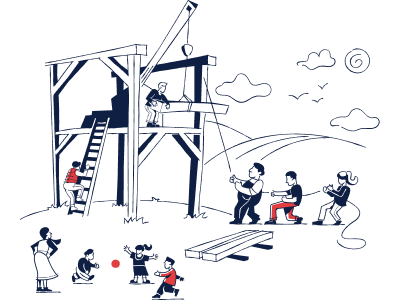
This annual report looks quite different, on its cover and in its substance. We are no longer refugees from a failed regime hoping to reach a better future. We have arrived, and we are staking our claim. A compass can aid intrepid explorers adrift in a vast ocean; it also helps settlers map their surroundings, build their infrastructure, expand their territory. This year, we launched Commonplace, moved into real office space, hosted a black-tie gala headlined by the Vice President and Secretary of State, published The New Conservatives, and became generally recognized as the most influential and effective policy organization on the New Right.
How do we do this? Lots of organizations conduct research and publish op-eds. Are ours better designed and written? No doubt. Does it help that our ideas are better too? Surely. But as important, we have impeccable credibility as good-faith actors, determined to get the answer right and tell the truth regardless of whose “team” likes it or not.
No other organization could be called both “the most intellectually honest tendency within the anti-Establishment right” by New York Magazine and “the cutting edge of populist economic and cultural thinking” by Steve Bannon. No other organization could have both the Teamsters and BlackRock proudly sponsor its fifth-anniversary gala.
A second dimension of our success is our commitment to engaging with fundamental ideas rather than merely promoting specific policy proposals and jumping into whichever fights happen to be dominating the news cycle. We really care about economics and the way its frameworks and assumptions shape politics and public policy, for better and worse. Thus, at the beginning of the year, I had the opportunity to participate in a panel conversation at the annual conference of the American Economic Association on the state of the discipline, which immediately received feature coverage in the New York Times (“Economists Are in the Wilderness. Can They Find a Way Back to Influence?”).
Such conversations and coverage leave deep impressions. Seven months later, they were still on the mind of National Public Radio host Amanda Aronczyk, who decided to do a feature story of her own. Rising distrust of economists, she explained, “has me thinking about this one particular discussion at the American Economic Association annual meeting, which took place earlier this year. This is a very big deal. Thousands of economists are in attendance.” Speaking with Times reporter Ben Casselman, who had covered the conference, she continues, “what struck me and Ben was the way that this panel kind of turned into a trial of the entire field of economics.”
Casselman then picks up the story. “There was, like, moments of, like, genuine tension there because it did feel like the profession, as a whole, was sort of being called out. … It was Oren Cass kind of reading the Riot Act to the profession. … I feel like in that moment, he sort of stood for a lot of Americans. Like, you guys keep getting it wrong. Why should we listen to you?”
Events like these shape how both practitioners and reporters think about what is happening in our politics, our economy, and our society—for the better. And even as we “read the Riot Act” to entire professions, we keep getting invited back, because we do it in a way that is thoughtful and respectful and recognized, even by those on the receiving end, as constructive.
Through such conversations, we also get the chance to meet folks like MIT professor Simon Johnson, last year’s Nobel prize winner in economics, which led to hosting him on the American Compass Podcast and identifying a shared interest in redistributing scientific research funding nationwide. Larry Summers invited me to speak to the several hundred students in his economics course at Harvard University on the political economy of globalization. Foreign Affairs solicited an essay on the future of American grand strategy, leading to events with prominent at scholars at Harvard’s Kennedy School and Yale’s Jackson School.
Interactions like these also underscore that relationships are key to changing minds. The best essay is no substitute for getting to know and talking with someone who is open to new ideas and can then carry them forward as well. That’s a third dimension of our success, and again one where we’re just built a little bit different, especially as compared to other conservative groups that seem to pride themselves on provoking and alienating the exact audiences they need to reach and persuade. We are sometimes asked what strategies we employ to get our ideas in front of key decisionmakers, and can only chuckle. Our policy team is working closely with them every day. We don’t need to send out a press release or hope to get mentioned in a news article that someone will pass along to someone who matters. We just give them a call.
My appearance on the Daily Show with Jon Stewart reached millions of viewers, who saw that he took our conservative thinking seriously and wanted them to as well. But that never would have happened if he hadn’t himself been interested in our work, spoken with me at length back when he was developing his Apple TV series, and then been impressed in our conversation on his podcast. Another good example is Walter Isaacson, the biographer, former editor of Time, and chairman of the Aspen Institute. He has interviewed me for his PBS show, and generously agreed to join me for an event at the 92nd Street Y in New York City launching The New Conservatives to an audience that would not usually listen to such ideas. Speaking recently on CNBC’s Squawk Box, he said “I read Oren Cass. I’ve been reading JD Vance, others. There is some sense to the fact that maybe those of us who believed in the Aspen-Davos consensus, that enshrined free trade as almost engraved on a tablet and handed down to us from the gods, no, that didn’t help a middle class in America.”
All these efforts come together to create tangible impact when we identify a policy issue for focus. From trade and industrial policy to labor, immigration, antitrust, family policy and more, the nation’s key policy debates are increasingly ones we have started and in which we are staking out the conservative position. Even on tax policy, where GOP orthodoxy has long seemed untouchable, we managed to reset the gameboard during debates over the One Big Beautiful Bill.
As The Hill reported, “Controversial think tank American Compass is working to make sure President Trump’s economic populism lasts well beyond his term — infuriating segments of the conservative establishment along the way.” Across the pond, The Guardian noted, “There’s every reason to believe that serious cracks are appearing in the Republican anti-tax coalition. First: why? The proposal itself is a brainchild of the conservative American Compass think tank.” In a post-mortem on the final bill, Politico’s Jonathan Martin said, “So who was pushing Trump on a top rate hike, so much so that he kept coming back to it? Grover Norquist fingers unnamed White House aides but does name one outside figure, who’s close to Vance: Oren Cass.”
Ultimately, both the President and the Secretary of the Treasury expressed support for raising taxes on high-income households. More than a dozen Republican senators voted for an amendment to do just that. We lost the battle over the contours of the particular bill, but we won the war over how conservatives should do fiscal policy. The old orthodoxy is out the window, and future fiscal debates will sound very different.
It’s very rare to see a shift so rapid in an ideological commitment so central to a political party, attributed to a single organization of any size—especially when we don’t spend our time putting out press releases and demanding credit. But with two major research projects, public-opinion polling, interviews with leading members of Congress, multiple op-eds of our own in the New York Times and Financial Times, publication of essays from other conservative commentators, and appearances everywhere from CNBC’s Squawk Box to Steve Bannon’s War Room; and thanks to the quality of the work we are pushing through all those channels; we are able to have that effect.
In the coming year, we will continue to develop and promote innovative policy solutions across our entire portfolio of issues, and begin to tackle new issues from health care to housing. We will also increase our efforts to give shape and substance to the contours of the conservative coalition, clearing ground and pushing boundaries to create the homestead on which a governing majority can reside. What began as a conversation among a small cadre of frustrated conservatives has become a genuine movement that includes countless allies in Congress and the presidential administration, boards of directors and advisors helping to guide our work, the rapidly growing Navigators Guild and Corporate Council helping to fund it, and a membership group of nearly 300 young policy professionals who represent the best of conservatism helping to carry it forward. We are grateful to all of you for your support and excited for the year ahead.

Return to the Annual Report:

2025 Annual Report
Staking Our Claim: American Compass’s 2025 Annual Report.
